Tuesday, 11 August 2015

The Bridge (2008)


The original Die Brücke was released in 1959, garnering international acclaim.  This remake received a much less positive reception, with German commentators feeling that it lacked the intensity of the original.  I've only seen this version, so I can't confirm the claim, but I wouldn't be surprised if it was true.  I'll discuss why that is, but I first I need to give you a precis of the movie for some context.

The basic outline of the film is pretty simple. The titular bridge is in a small German town during the closing months of World War 2.  Seven local boys, who have somehow managed to retain their naive romanticism about the war, are drafted into the military.  This appears to be an arbitrary decision from the top, not one requested by local commanders, as the latter are well aware that a handful of untrained teenagers will not make any difference to the outcome of the war.

The youngsters are assigned to 'guard' a bridge, more or less as a means of keeping them out of the way while the real soldiers pull back.  The only trained soldier left with them has orders to send the boys home once the wounded have been evacuated.  However, he decides to desert his post instead, so the young men never get that order.

Thus, when US advance forces arrive the seven boys fight to defend their bridge.  Somehow they manage to put up enough resistance that the American scouts withdraw to await reinforcements.  The action leaves only two of the youngsters alive, however, and they are horrified when they discover that German sappers are readying to blow up the bridge that their friends died to hold.  They drive the sappers away, though one of them is fatally wounded in the process, leaving only a single, shell-shocked survivor as US forces roll into the town once more.

Clearly the whole point of the movie is the futility of the struggle these young men endured.  Toxic ideas about manhood and nationalism lead them to fight and die long after the real army has withdrawn, and in the end they manage to hold up the enemy for a matter of a few hours at most.  Then the one thing they might actually have achieved - giving the sappers time to destroy the bridge and thus deny it to the enemy - they undo because they don't even understand why they were defending it.

Understanding the point the film is trying to make is not the same as actually feeling it, however, and it there that the movie fails.  We never really get to know five of the young men, so their deaths have little emotional weight, and one of the two who we do get to know is a sexual predator, so I'm not exactly choked up about his death, either.

This film shoots wide of the mark.

Monday, 10 August 2015

Midway (1976)


Imagine you and someone else are each given a machete.  Then you are both locked in a pitch dark room and told you can't leave until one of you is dead.  Whatever nutcase is running this game then randomly lights up small sections of the room for brief periods of time.  If you happen to be looking in the right direction, you might learn something.  If you happen to be in the wrong place, you may be fatally exposed.

That's obviously not an exact analogy for the nature of naval engagements in the Second World War, but I think it gives some idea of the atmosphere.  Two forces with the capability to devastate each other, each dangerously vulnerable at the same time, desperately groping to find the other before their own location can be exposed.  A single moment of luck - good or bad - could decide the engagement.

This film does an admirable job of establishing the stress and strain of warfare under these circumstances: knowing that every order to launch your planes, or to change their armament, could be the key to victory -- or the cause of your death.  I've seen some accusations that the film is 'slow', and it certainly doesn't have much in the way of whizz bang action to it, but I think that's a very deliberate and sensible decision.  Frenetic action scenes would alleviate the tension the film is attempting to create.

The historical Battle of Midway came about due to the Japanese desire to cripple the US Navy's carrier force.  The location of the conflict was not of itself of any intrinsic importance to the Japanese war effort; it was simply somewhere they believed (correctly) that the US would feel compelled to defend.  The movie depicts the ensuing engagement pretty faithfully - or at least faithfully to how it was understood at the time of the film's production.  Some of these ideas have been challenged in the past decade or so.  Still, you're not going to see a U-571 or Bruckheimer-esque Pearl Harbor here.  Thumbs up for that.

For my tastes Charlton Heston looked a mite too smug in all his scenes, but other than that I found Midway a solid account of an important engagement in WW2.  If you have an interest in history - particularly those times where small things have large impacts - then you should check it out.

Friday, 7 August 2015

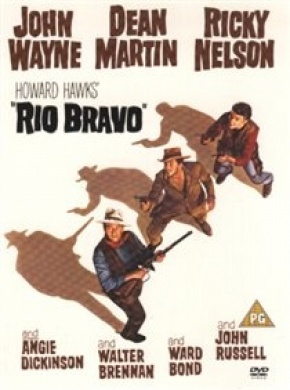
Rio Bravo (1959)


In the earlier days of this blog I worked my way through a pack of John Wayne movies. They were mostly very slight affairs, cribbed from his 1930s career in Hollywood's "Poverty Row".

This movie is a rather different proposition. It was during the long period when Wayne was one of the world's most recognisable stars, with hits like Stagecoach, Sands of Iwo Jima, and The Searchers behind him, and others like True Grit still to come. It has star power behind the camera as well, in the shape of renowned director Howard Hawks.

Rio Bravo begins with an arrogant gunslinger shooting a man in cold blood. He's promptly arrested by Sheriff John Chance (Wayne, of course), but this is far from the end of the matter. It'll be more than a week before a US Marshal can reach the town to handle the case, and the murderer is brother to the richest man in the territory. There's no way this wealthy and ruthless land baron will stand by and allow his sibling to pay the consequences of his crime.

Thus the sheriff finds himself more or less besieged in his office as the land baron put his money and men to work on the problem of freeing his brother. And if that takes a few more killings, well that's a price the murderer's brother is willing to pay.

Sheriff Chance gets offers of help from several friends, but declines most of them. "Putting well-meaning amateurs in a fight with trained men will just get a lot more people killed.", he reasons. The only allies he accepts are Dude – a former gunfighter recovering from a two-year drinking spree – and Stumpy, a tough and garrulous old timer. Not everyone is going to accept being told to stay out of it though: a cool young hired gun named Colorado takes an interest, as does the feisty and tempestuous "Feathers", a young woman who takes a shine to the Sheriff.

Rio Bravo is well-acted and has a solid script with some snappy dialogue – especially from Angie Dickinson as Feathers. She is so good in the role that you almost forget she's more than twenty years younger than Wayne. Almost.

The film's only got two real weaknesses. The first is its depiction of two Mexican characters: they're good people with lots of positive qualities, but they are also pretty clearly "comedic ethnic sidekicks". This is, after all, a 1950s film. The second flaw is the climactic battle between Chance's group and the land baron's (much larger) forces. It's a curiously tepid and one-sided affair, without much tension. It's not a huge problem, but it is noticeable that the bad guys seem much more competent and menacing in earlier scenes.

These issues aside though, this is a well-made and enjoyable film. Wayne and Hawks apparently had a second stab at the concept in 1966 in El Dorado. I think I might need to track down a copy of that.


Thursday, 6 August 2015

The Phantom from 10,000 Leagues (1955)


It's always a good feeling to finish one of these 50-pack box sets.  I mean sure, given Mill Creek's propensity to duplicate films between boxes it generally works out to be more like 40 movies, but that's still quite a lot of time in front of the TV.  And this box set has even been a good one: it would have been worth the twenty-odd bucks I paid just for an unbutchered copy of Night of the Living Dead, but it also included a half-dozen other films where I found something to recommend them, plus a couple of silent era films that I wouldn't tout to others, but were of interest to a cinema geek like me.  Even a couple of the stinkers had the decency to be so bad they were good (yes, Beast of Yucca Flats, I am looking at you).

The fact that I have spent the first paragraph of this review talking about the other films in the box set might clue you into the fact that I don't have much positive to say about this one.  In fact, I think I can sum up the things I like about this movie in one sentence: "It's the last one in the pack".

The movie begins with a fisherman hauling up a net and apparently being completely oblivious to the really obvious monster rising up right beneath him.  This gets him horribly mauled.  Or so we are told when his body washes up on shore.  We don't get shown it, of course.

The source of the monster is going to turn out to be a "radioactive beam of light" beneath the waves.  Who placed this "death ray" (no really, that's what they call it) there and created its guardian is what two government investigators hope to find out.

I've seen one review of this movie which complains that it has too many characters to keep track of.  I don't agree with this claim.  There are only seven notable characters - that's no more than say Aliens (Ripley, Newt, Hicks, Hudson, Burke, Gorman, Vasquez) or the 90s version of The Parent Trap (Hallie, Annie, Mum, Dad, Chessy, Martin, Meredith).

The problem with this movie's characters is not how many of them there are.  It's that they are all unremittingly dull.  Like the rest of the film, in other words.

Wednesday, 5 August 2015

The Green Hornet (2011)


I'm not sure who thought that making The Green Hornet into a Seth Rogen vehicle was a good idea, though presumably Rogen himself was among them.  And I guess, if I squint really hard, I can even see a semblance of logic to it.  Rogen is well suited to play the vacuous playboy that is the Hornet's public identity, after all.

Where the concept - and thus the film - falls down is in making this version of the character a vacuous playboy in his crime-fighting identity as well.  This is not a man who fights crime to protect society from the losses he has suffered or because he is driven to right the world's wrongs.  He fights crime because it lets him roar around town in a hotted up car and beat people up.  Both of which he can only do thanks to his martial-arts-expert-and-mechanical-genius offsider, Kato.  Not that Kato is an any better person than his boss.  He's a lot tougher, sure, and brilliant with machines, but he's just as much as a dudebro in pretty much every other respect.

Now it's true that the Hornet's lack of substance does tie directly into the central theme of the film: the juxtaposition of appearance versus ability; and the value and weaknesses of each.  If you have enough style, can you get away with having no substance?  And if you have no style, will your ability always be overlooked?  These are questions the film is asking from almost its first scene.

On the other hand, while the film is clear about the questions it wants to ask, it is very muddled about what, if any, answers it might have.  And 'muddled' is a good summation of the film in general, as it is tonally all over the place, treating violence as grim and terrible in one scene and as the height of comedy in the next.  It's also deeply misguided in its depiction of its "heroes": they both come across as schmucks, frankly.

While there are a few laughs here from time to time, there are a lot more groans.  Skip it.

Tuesday, 4 August 2015

Last Man on Earth (1968)


Richard Matheson's I Am Legend is considered a classic horror novel, and is cited as a seminal influence by many modern authors.  However screen adaptations of the work have generally been rather bumpy.  Charlton Heston's Omega Man took nothing more than the basic concept of a man besieged by noctural monsters, as did the Asylum's I Am Omega mockbuster.  Conversely, Will Smith's 2007 adaptation was doing fine until the inexplicably thick-headed ending (a much more thematic alternative ending was also shot, but not used because who knows why - you can get it on the 2-disc DVD of the film, apparently).

Before all those other films though, came this one.  Matheson actually worked on this movie, but asked to be credited under another name when he was dissatisfied with the final product.  His objections were two-fold: rewrites of his script, and that he did not think Vincent Price was the right choice for the lead role.

I'm not all that sympathetic to Matheson's first complaint (and I wonder what he thought of the other adaptations, given how much more faithful to his book this one is), but I can admit there might be some merit to the latter.  Price was a capable actor, but he's just a bit too erudite and urbane for this role.  The movie would have benefited from a performance with more of an edge of desperation and strain.  The film is also undermined by some poor dubbing into English (most of the cast are Italian), and the production values are mediocre due to its low budget.

Despite these flaws, I think the movie is worth seeing.  It is an effective piece of film-making, and does a good job of establishing a sombre mood, which is eminently suitable for the kind of tale it is telling.

The basic plot, you see, is that a strange malady has swept the world.  Those infected by the disease take on the traditional traits of the vampire: an aversion to sunlight, garlic and mirrors, and the need to feed on blood.  One man - Dr Richard Morgan - seems somehow immune to the illness.  He spends every night besieged in his fortified home, emerging each morning to hunt for the hiding places of those who have succumbed to the disease.

And then one day, he encounters a young woman, also out in the sunlight.  She runs from him, but he catches her and brings her to his home.  Is this the companion he's longed for in his long period of isolation, or is there some other explanation for her appearance?

Check this one out if you want to see a film adaptation that hews close to Matheson's acclaimed novel in tone, if not always in its details.

Monday, 3 August 2015

Ghidorah, the Three-Headed Monster (1964)


Possibly because this film got its own US version and release, my Godzilla boxed sets don't include this movie, so I skipped it when I was working my way through the franchise a few months ago.  It's a pretty important film in Big G's progression however, as it is the one where he goes from villain to hero (at least until the franchise rebooted about 15 years later, anyway), so when I found a copy available as an individual disc, I picked it up.

As with all Godzilla movies, we've got parallel kaiju and human stories here.  The giant monster action revolves around the titular Ghidorah, a three-headed space dragon that destroyed all life on Venus 5000 years ago and now intends to do the same to Earth.  The human-scale narrative meanwhile focuses on the princess of a fictitious country, who not only becomes the instrument through which the remnants of Venusian civilisation attempt to warn humanity, but is also being chased by assassins due to political upheaval in her homeland.

Big G's face turn also saw the franchise head in a much more kid-friendly direction than it had previously followed, and this film really marks the beginning of that change.  The kaiju battles are largely played for laughs, rather than drama.  For instance, at one point Ghidorah's lightning breath hits Godzilla in the butt, and Big G leaps into the air, holding his posterior.  For seven year old boys, that's comedy gold.  For the rest of us, though ... meh.

The rather light-hearted, slapstick air extends to the assassination plot as well, believe it or not.  Although "let's murder someone" is a fairly serious kind of sub-plot in general, the would be assassins in this are so bad at their jobs that it feels more like they are playing at being killers rather than actually trying to harm her.

Ultimately, despite the fact that the dialogue claims that humanity will be destroyed if Ghidorah isn't stopped, the whole film feels very lightweight.  The comedic fight scenes ensure that there is no sense that there is any risk, and the 'dramatic' moment where Big G decides to fight on the side of good is pretty much bungled: watching the monsters bellowing at each other while someone 'translates' their conversation is not exactly riveting entertainment.

This one is for Godzilla completists only.